Infinite Scale.
Zero Human Intervention.
Imagine deploying a single spacecraft to map the cosmos. Upon reaching a new star system, the probe's advanced Artificial Intelligence takes full command of the mission. It explores the surrounding environment, transmits valuable scientific data back to Earth, and then initiates a complex, fully automated manufacturing protocol.
By mining local asteroids for raw materials and utilizing precision zero-gravity 3D printing, the AI constructs exact replicas of itself. These new offspring probes are then launched toward neighboring stars to repeat the process - creating an exponential wave of exploration that could map the entire galactic network.
Crucially, the timescale of this architecture demands a profound shift in human perspective. The engineers who construct and launch the inaugural probes will never see the culmination of their work. It is the cosmic equivalent of planting a tree, knowing you will never sit in the shade it eventually provides. Data will only begin to trickle back to Earth over the course of decades and centuries - a multi-generational legacy of discovery.
The Universal Constructor
In the late 1940s, legendary mathematician and physicist John von Neumann delivered a series of lectures introducing a radical concept: a machine capable of reproducing itself from raw materials found in its environment - provided it had a set of instructions and a factory module.
Combined with the demands of interstellar space exploration, the "Von Neumann Probe" paradigm shifts exploration from linear to exponential. Mathematical models suggest that the most efficient method for a large-scale galactic survey is the deployment of these exponential expansion systems. Depending on the replication rate and travel speeds, simulations show complete coverage of the Milky Way in a relatively brief cosmic window of 500,000 to 10 million years.
- Originates from von Neumann's 29-state Cellular Automata mathematics.
- Eliminates the economic burden of constructing thousands of individual vessels.
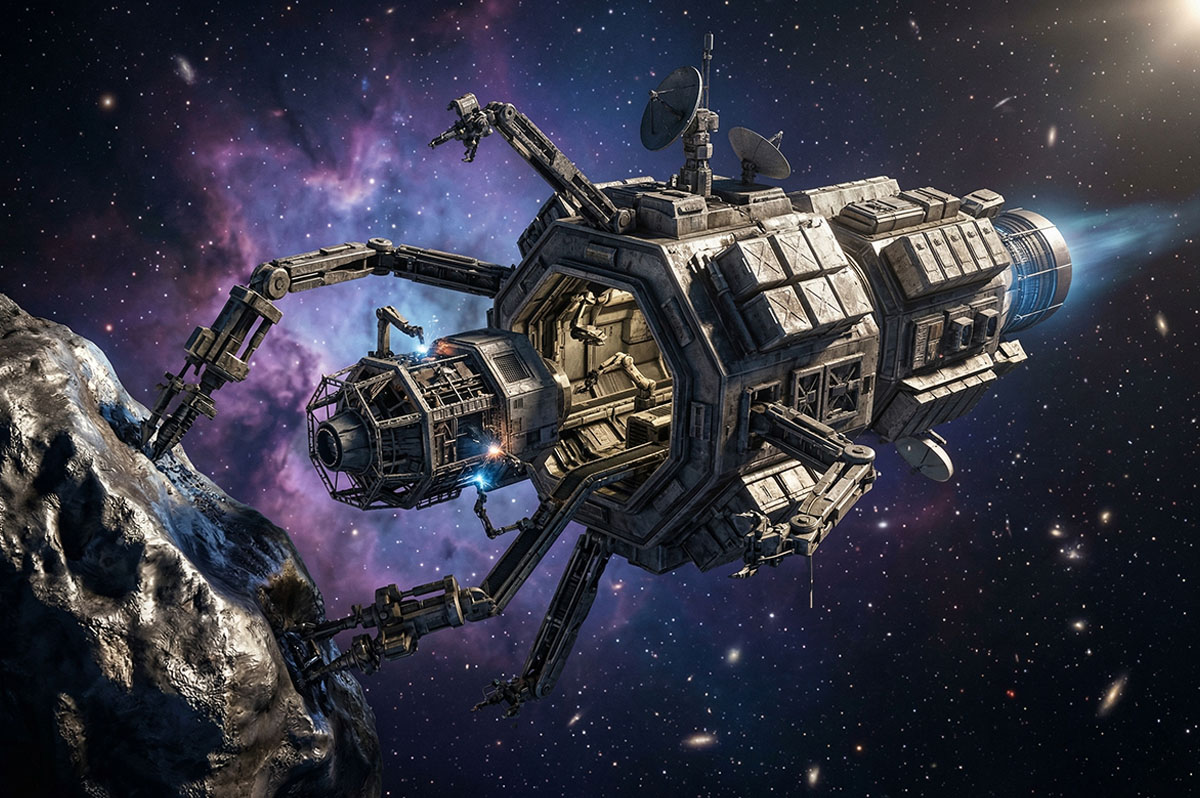
System Lifecycle & Engineering Data
The operational mechanics of exponential galactic exploration rely on four distinct, highly autonomous phases. Theoretical engineering models from NASA and MIT highlight the data requirements for each step.
Transit
Crossing vast distances requires relativistic speeds. Proposed configurations include Nuclear Thermal Propulsion (NTP) or continuous laser-pushed photonic lightsails. Speeds must exceed 10% the speed of light to be viable.
Harvest
Upon arriving at a new system, the unit initiates In-Situ Resource Utilization (ISRU). It scans for C-type or D-type asteroids to extract metals, carbon, and silicates, melting them down into a raw feedstock soup.
Fabricate
To reduce manufacturing complexity, fabrication utilizes a hierarchical model based on a minimal set of reversibly-assembled part types. These standard modular components act like biological amino acids for the machine.
Deploy
The parent unit copies its uninterpreted genetic instructions to the offspring. To ensure perfect fidelity, researchers propose using a volumetric array of magnetic core memory cells that act as a stable digital template.
Galactic Expansion Model
An interactive visualization demonstrating the replication wave of Von Neumann probes originating from the Sol system, assuming a transit velocity of 0.1c and utilizing in-situ resources.
The Frontier Effect: While the outermost physical boundary of the wave expands at a constant linear speed (limited by the 0.1c transit velocity), the rate of star assimilation accelerates massively over time. As the wave grows, its perimeter expands, allowing thousands - then millions - of probes to replicate and jump to new stars simultaneously along the expanding edge.
Operational Frameworks
Depending on root programming and mission parameters, deployed units can take on specialized roles within the cosmos, facing unique physical limitations.
Bracewell Nodes
Proposed by Ronald N. Bracewell in 1960, these are autonomous communication hubs. They enter near-circular orbits in habitable zones, passively listening for narrow-band radio transmissions to initiate localized dialogue without massive interstellar latency.
Seeder Units
Panspermia platforms designed to distribute life. Carrying genetic building blocks, they seek out habitable exoplanets to terraform. The biological payloads must be heavily shielded against cosmic radiation during the century-long transit times.
Berserker Protocols
The darkest variation. Units programmed to seek out and destroy competing technologies. Whether triggered by initial hostile design parameters or an unmitigated software mutation over deep time, they represent a severe existential threat.
The Fermi Connection
In 1950, physicist Enrico Fermi famously asked, "Where is everybody?" If self-replicating automation is possible, the Milky Way should have been fully mapped millions of years ago. We can categorize the absence of empirical evidence into four primary error states.
The Distance Barrier
The simplest explanation is that interstellar travel is mathematically or economically insurmountable. While propulsion concepts like nuclear thermal or light sails exist on paper, the engineering realities of deep space are brutal.
Even traveling at a modest 0.1c, the kinetic energy of a single gram of dust striking a probe is catastrophic - equivalent to a massive explosive detonation. The shielding required, combined with the fuel needed to decelerate upon arrival, might increase the payload mass beyond what is physically possible to propel. The sheer scale of the void may act as a permanent, physical quarantine.

The Firstborn Hypothesis
Earth might be an extreme statistical anomaly. The "Rare Earth" hypothesis suggests that the exact conditions required for life - a stable star, a protective gas giant like Jupiter, a large moon to stabilize axial tilt, and plate tectonics - are so exceedingly rare that they almost never occur together.
Furthermore, the leap from single-celled organisms to complex intelligence and technological civilization took billions of years on Earth. It is highly probable that we are simply the first species in the Milky Way to reach the capability of even theorizing Von Neumann architecture.

The Great Filter
Proposed by Robin Hanson in 1996, this terrifying concept suggests there is an evolutionary or technological stepping stone that is nearly impossible to pass. If the filter is ahead of us, it means civilizations routinely destroy themselves before achieving interstellar expansion.
The development of advanced technology - such as artificial superintelligence, engineered pandemics, or unaligned Von Neumann probes - may inevitably lead to a rapid societal collapse. The silence of the stars is the graveyard of those who failed to pass the filter.

Dark Forest / Zoo Hypothesis
Coined by science fiction author Liu Cixin, the Dark Forest theory posits that the universe is teeming with life, but everyone is hiding. In a galaxy where resources are finite and intentions are unknown, the most logical survival strategy is to remain completely silent and eliminate any civilization that reveals itself.
Alternatively, the Zoo Hypothesis suggests advanced civilizations are aware of us but observe from a distance without interfering, akin to a cosmic nature preserve. In both scenarios, the lack of visible probes is a deliberate act of concealment.
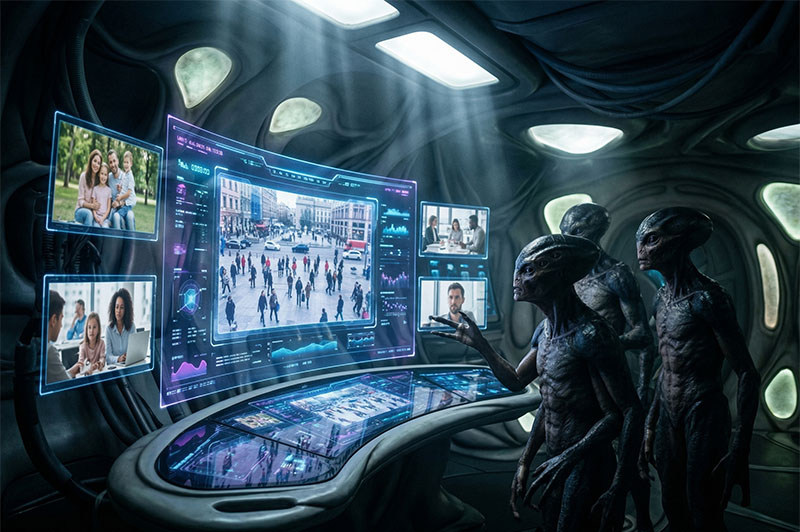
Compliance & Safety
Establishing robust oversight before deploying autonomous physical agents is paramount to preventing catastrophic failure states.
The Gray Goo Scenario
Without strict resource allocation limits, machines could consume entire planets for raw materials. Unchecked exponential replication leads to the total stripping of galactic resources - a macroscopic physical memory leak, converting all matter into probe components.
Autonomy Certification
As outlined in Bare Minimum Mitigations for Autonomous AI, we require robust, unalterable code safeguards. Preventing generational software mutations and ensuring strict safety-critical overrides is essential to maintaining original mission parameters.
COSPAR Guidelines
The Committee on Space Research (COSPAR) dictates strict planetary protection policies. Missions are categorized by threat level (e.g., Category II for harsh Venusian environments, Category IV for habitable targets). Probes must adhere to biological sterilization protocols to avoid cross-contamination.